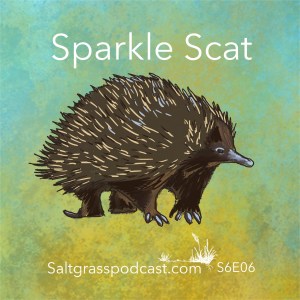
What can animal droppings and footprints tell us? Quite a bit it turns out.
In this episode we follow the Desert Discovery tracking team around for a day and one of the first things we find out is why echidna poo sparkles.
I feel like my day with the tracking team forever changed how I observe the ground beneath my feet and what can be seen, via tracks and scats. Often the marks are very tiny and very subtle, but they’re there.
They’re indications of all the life that we coexist with that we often don’t see. All the critters that we share our world with that are often invisible to us because they don’t wanna be seen by us. But they are there, and we are sharing our landscapes and our ecosystems with them.
Links:
Transcript
Ep 6 Sparkle Scat
Trish: It’s very solid and uniform, it’s not cracked or anything. And then I can see sparkles in it. So echidnas eat ants basically, and they have a lot of that hard…
Libby: Exoskeleton …
Trish: exoskeleton.
Allie Narrating: Welcome to another episode of our Desert Discovery series of Saltgrass. What you’re listening to is Trish from the tracking team examining a piece of scat or poo. I had found it on the day that I went out with the tracking team.
You met these guys in the last episode when we were talking about the long shots, and they helped us identify whether or not we’d found bilby mounds and burrows.
On this day I had found an interesting piece of poo. Trish was looking at it, and the whole team came together to discuss what it could be. And as you can hear, she very quickly identified that it’s probably an echidna poo. The sparkles in the scat were the remnants of the various insects they’d eaten that had shiny shells or exoskeletons.
Trish: I’m going to risk it and pick it up and break it. ‘Cause I can’t do it any other way. It feels like rock. And then I’ll break it in half. And you can see all sorts of little bits of shell and-
Libby: It’s not herbivore.
Trish: … things in it. Yeah. It’s not quite as sparkly inside, but-
Libby: It might be quite old
Trish: you can still see some sparkles in it.
Joss: There’s nothing else it could be, really.
Trish: There’s nothing, yeah, so it’s a good one. And echidnas are one of the species that cover the entire Australia.
Allie: Do we keep it, or?
Trish: I would tend not to. You can see a little bit of beetle there.
Allie: Oh, yeah.
Libby: Did you say you were not going to keep it?
Allie: Would the mammals and reptiles team…?
Trish: Would like to see it, do you think?
Christine: Well, I’m sure they would.
Libby: Yes, please.
Trish: You’re welcome to take it back.
Libby: Good.
Allie Narrating: We then scrambled around trying to find an appropriate bag or container to put the sample scat in, and none of us had brought the designated paper bags that had been given to us to collect scat samples in. So we made do. As you often do out in the desert, you just make do with what you’ve got on you.
Libby: Here we are. I didn’t put a…
Allie: This is why we have muesli bars, isn’t it?
Trish: No, I forgot to put the thing in my pocket.
Libby: Do not eat.
Allie: (laughs) Morning tea tomorrow.
Libby: Tastes like formic acid.
A lot of times we’ve been seeing, on a tree trunk, there’ve been hollows that are about this high off the ground, and that’s very typical for echidnas to climb up into. So they climb very well.
Trish: They climb cliffs
Libby: Yes. And platypus climb.
Christine: Oh. I wouldn’t have expected them to climb.
Joss: I just want to point out that it’s 12:00, so we’re getting into the territory of do we have time to get back and have lunch before the meeting.
Allie: Stopping for poo. I’m excited by that.
Libby: I think that’s wonderful. I think it’s one of the finds of the day.
Saltgrass theme music and standard episode intro:
A couple of years ago, my partner and I drove three and a half thousand kilometers from our home in Castlemaine, Victoria, across the Nullarbor and into the remote deserts of Western Australia. Our destination was a place called Yeo Lake Nature Reserve to join a citizen science group called Desert Discovery.
For two weeks we camped with them and each day was an adventure to see what life is out there in the desert. A treasure hunt for rare and obscure species. I took along my sound recorder and went on a treasure hunt of my own for stories about who these people were and why they were doing this. Season six of Saltgrass is still about salt of the earth people and grassroots change. It’s just a bit further from home.
(music)
You can hear all episodes of Saltgrass on your podcast app or at saltgrasspodcast.com. Saltgrass is produced on Djaara Country, home of the Dja Dja Wurrung. Yeo Lake Nature Reserve is on Central Desert Country where the Yuka people, the Sullivan and Edwards families, and the Ngaanyatjarra and Nangaanya Ku peoples have walked for thousands of years.
Always was and always will be Aboriginal land.
Allie Narrating: So in this episode of our Desert Discovery series, we’re going to be following the tracking team around.
Trish and Joss are very experienced in tracking, and we will talk to them later in the episode about their life experience and their professional experience. But I thought we’d start the episode with an explanation of their process.
So, as explained a little bit in the last episode, the tracking team focuses on what’s discoverable in the landscape, be it footprints or tracks, scat or poo, or other remnants or indicators of particular animals’ lives.
Trish and Joss had a team of six people, including themselves. And then also on this day, Libby joined us. And Libby, you heard her voice last episode, but I didn’t really introduce you to her. She is an amazing person, and we are gonna spend a whole episode talking to her just about her life and her experiences. She drove solo from Sydney right across through the Red Centre to join us in Western Australia she’s extremely knowledgeable and interesting, but she wasn’t a regular member of the tracking team, so she and I were both, playing catch up a little bit, and Trish and Joss started the day by explaining their method to us, and that is what we’re about to hear.
Trish: I’m Trish Macdonald. Here at Desert Discovery, Joss and I are working on the tracking and scats survey.
Joss: And I’m Joss Haiblen. And the particular focus of the tracking survey is on the larger animals, both ferals and native. The smaller reptiles and mammals we hope to see turn up with the mammals and reptiles team with the pitfall traps and elliot traps and so on.
There’s a special focus on both ferals to see what their impact might be on the natives and on the threatened, keystone, arid zone species such as greater bilby and great desert skink. And for this particular project, we have also a focus on Malleefowl, as they used to be here and they’ve been detected recently not too far to the southwest of here.
Trish: It would have been about 12, 15 years ago, that they decided to set up an arid zone tracking process so that they could get uniform data tracking and surveying for animals across the whole of the arid zone in Australia. So it’s quite a large area. And they came up with some standardized techniques. So we’re using one of those standardized techniques.
It’s a method that was developed to use across the whole of the arid region and to be a relatively simple and systematic process so that the same technique could be used, because the arid region so huge, and therefore the data could be all fed into the one thing, and it would make sense instead of multiple different methods of trying to detect things.
Where it became difficult to compare methods between, say, Western Queensland and parts of WA where you might have the same species, but they’re using different techniques and comparing those becomes really difficult. So it’s been going for about 12 years now.
And so we picked up that method. We had a talk with Rachel Paltridge at the time who was working out of Alice Springs as an ecologist. And that was the recommended technique. So we just learnt it. The same technique is used by indigenous ranger programs and things.
What we’re looking for is tracks of animals, scats, and diggings and burrows of specific animals that occur in the arid zone. So we’re not just looking for bilbies and great desert skinks, but they’re the threatened species that cover this region that we might do. The technique we’re using for tracking is to do a two-hectare plot, is basically 100 meters across and 200 meters long.
So there’s different ways of searching that. So, often with Aboriginal rangers and traditional owners, they will come and they do a 20-minute search of that plot. They’ll wander around. Their skills are infinitely greater than any of our skills. So what we came up with was a more systematic way of searching the plot to try and ensure that we didn’t miss important detail.
And what we’ll do is, on this line here, a group of us will be spaced so that we can talk to each other, and we’ll do a line search. So we’ll all walk in the same direction, staying roughly parallel, and you call out, or using the radio, anything you find. And then we’ll go up and turn around.
Joss: And come back.
Trish: And come back. Now, that’s the traditional one and that’s appropriate often for bilbies and a lot of other species. And then the thing that sounds a little bit radical, and when I first heard it I thought, “Oh, how is that ever gonna work?” You do one of those plots every five kilometers. So even though the five kilometers is consistent, there’s a randomness to it across the landscape.
And I thought, “How do you find anything if you’re looking for a bilby or something?”
The process worked really well when we were at Tjirrkarli, and it worked really well on the road up to Balgo when we did that trip. Before we did the searches in Tjirrkarli, we talked with people who worked with great desert skink, and the recommendation for great desert skink was actually a four-hectare plot, not a two-hectare plot.
So what we decided to do was to do two two-hectare plots side by side. So we call them plot A and plot B, we found that by doubling the plot going away from the road, that we more than doubled the results for bilby. Because we’re also looking for great desert skink here, we’re doing the four-hectare plot.
For each plot, I record a variety of different things. So I record the weather. Basically, is it a clear sky, a light sky, or a thick cloud? Whether it’s windy or not windy. Trackability, which is how easy is it to see a track. So, this is like prime trackability sand, and then we will come across clay where you might see camel track, that’s it, you know, you won’t see anything else. So we’re looking for that.
I’ll assess the fire severity, which out here is long unburned in this particular site. The habitat, I make a generalized habitat assessment, such as sand plain, spinifex, a lateritic rise, a mulga woodland, and we record that.
Presence of bilby foods, if we can recognize any.
There’s a standard list of species that you’re looking for. They’ve got goanna perentie, and blue-tongue, great desert skink. Woma and other snake. We’ve had snakes on the plots in the last couple of days, one which we suspect may be a woma. A aoma is a desert python, very large, they can grow up to two and a half meters, they’re quite a large snake. Emu, echidna, bilby, mulgara, hopping mouse, marsupial mole, red kangaroo or euro, rabbit, cat, fox, dingo, camel, and horse, donkey, or cattle.
The main ones, we’ve had emu scat and emu prints.Red kangaroo/euro. We’re not trying to distinguish which one’s which. Rabbit, cat, dingo, and camel. They’re the main ones we’ve gotten.
As we’re going along, the process is once I’ve recorded, for example, camel. If someone sees a camel track, they call out, “Camel track.” And if it’s fresh, I mark that down.
Now fresh is one to two days. Old is three to seven days. And then very old is anything older than a week. Once we’ve seen those tracks, we no longer need to pay any attention to camel tracks. Okay?
Joss: Until you get to plot B.
Trish: Until you get to plot B, and we’ll start you again then. Similarly with the scat, we’ll age it as well.
It’s either fresh, old or very old, and we’ll give you some descriptions once you find it. That’s why this will take longer than normal when we’re getting our eye in and learning.
All the recording has to come through me, so use of radios. If everybody has a radio it’s much easier, but we can deal with someone on either side who doesn’t have a radio.
Joss will do the reference line, so he’s GPSing that. And he will record, he’ll track where he goes. And that’s mainly so that we make sure we cover the plot properly.
Joss: So we’ll start everyone in a line with a certain distance apart, and I’ll be on the left of that first line. So if the next person is Trish, her job is not to decide, “We’re going that way,” but to watch me and to stay that equal distance.
Trish: Keep your spacing equal, and it will always be based off Joss’ setting the route. It’s not that we need to be absolutely accurate on this line search. The line search is our way of ensuring that we actually have covered the plot.
Joss: And in thick vegetation you should wander a little bit. Like, if this is roughly gonna be your line keeping equidistant to who’s on your left, if there’s some thick vegetation…
Libby: You don’t have to walk through trees?
Trish: No.
Joss: No, you go around.
Trish: Walking through trees and walking through bushes is not gonna tell you anything. (laughter)
Joss: Can I say a bit more just about the species? So the gold star product that the Arid Zone Monitoring Project is hoping to find out of the tracking surveys is the threatened species. Bilbie and the great desert skink. And the mulgara. I better draw a mulgara. So, you know how the rabbits pop in with their hind feet forward, and then the two like that, right?
And the same with the bilby, really. Bilby’s very similar. So if you see anything like that, call our attention to it.
And in terms of disregarding things, we’re not really after all the small dragons, and skinks, and other lizards, because that’s the purpose of the trapping program. I guess we would like to know about large lizard holes.
Trish: That kind of looks like they’ve got a flat bottom, and then it’s this shape above it. And there can be a little bit of a bump on the bottom in the middle there. Rabbits will generally have more of a peaked top on it like that, and bilbies are more a rounded type hole, but with a big spoil heap coming out.
Allie Narrating: Shortly after this explanation, we began. And I have to say, I felt entirely unprepared. As they’d been talking about the different animals, Joss and Trish had been doing little marks in the sand to show us what the animal prints looked like. So we had a little bit of a visual guide, but, as a first-timer I felt a little intimidated. But, it actually was really fun, and very quickly I found myself seeing things that on a different day I never would’ve noticed.
As soon as anyone saw anything, they would say it on the radio. The whole line would stop where they were, and then Trish would come over to where that person was. They would look at what had been found together, and Trish would note it on her clipboard, or she’d say, “Yeah, don’t worry about that one. We don’t need to know about that one.” And then everyone would get back into their spot in the line, and we’d continue on.
The walking pace was obviously very easy because we were going slowly so that we could see everything that we could see. It was just actually a really enjoyable day, and from that day onwards, I was seeing tracks everywhere and I still do. In Central Victoria, most of what we see in the bush is kangaroos or wallabies, we don’t have a lot of wild dingoes out here. But, yeah, I feel like my day with the tracking team forever changed how I observe the ground beneath my feet and what can be seen, via tracks and scats. Often the marks are very tiny and very subtle, but they’re there.
They’re indications of all the life that we coexist with that we often don’t see. All the critters that we share our world with that are often invisible to us because they don’t wanna be seen by us. But they are there, and we are sharing our landscapes and our ecosystems with them.
A day or two after having walked with the tracking team, I sat down with Trish and Joss and asked them a bit more about themselves, their life experience, their professional experience, and how they came to be on Desert Discovery.
Trish: We first came across Desert Discovery through Australian Geographic. It was a Desert Discovery that happened in 2002 and it was the Desert Discovery trip that was done into the Plum Ridge Lakes in WA.
We thought, oh, this is fantastic. And so we contacted Desert Discovery. But, of course, at that particular stage they were absolutely swamped because of this article in Australian Geographic. And they were particularly focused on a couple of different things. But, the one thing they wanted at that time was they wanted younger people, like children, to come out and explore and experience the desert. And we were fortunate in that we had two children, and so they got us into Desert Discovery.
Allie: How old were they at the time?
Trish: They would’ve been about 13 and 15. So we went to Percival Lakes Camp. At that time so many people were going to Desert Discovery that they used to rotate you through. So that was very early in the scientific development of it. But we arrived with our two kids and were fortunate to cross over with the Hancock family who were original Desert Discovery people who also had teenagers. And it was absolutely fantastic.
There was an ornithologist who’d set up mist netting. He was wonderful working with the children. Everybody was really enthusiastic about having younger children and the kids being involved in things. And it was good having a range of teenagers there, there were about six of them weren’t there?
Joss: mmm
Trish: I think six or seven. And they could gang up and go off and have their own campfire together and things like that. But, one of the best things that happened there was they decided to do a puppet show. One of them was really into theater and they did a sock puppet show that was hilarious. A takeoff on all these old people.
Allie: the people at camp? (laughter)
Trish: And they didn’t pull punches. They were, you know, teenagers where they just went for it, and it was hilarious.
So that was a really wonderful experience to have that. And then as often happened the children got older and involved in a lot of different things, so they haven’t been back. But we have. So, this is our fourth. And so the last three we’ve done the tracking survey specifically and led that.
Allie: And so what’s your background? How do you come to know how to do tracking surveys?
Trish: Well, we both started out in outdoor education and guiding in wild areas. And we worked together in Canada and Nepal and Australia and various places around the world. And then we made a career change and became park rangers. We went back to university and studied ecology and things and became park rangers.
Allie: And where, where were you at that point?
Trish: In the ACT. So, there’s a large national park there that we worked for for 10 or 12 years.
Joss: But we worked across the Australian Alps as well. Because there was a cooperative agreement with New South Wales and Victoria going right through the Alps.
Trish: So quite broad. And then we diversified. Joss went into the federal public service. And what did you…?
Joss: Oh, worked in initially in indigenous employment. So, there was the old community development employment program and ended up, this was the most interesting part, in kicking off the Working On Country program, which is what established all the ranger groups around the country.
That was very interesting and satisfying work and it’s great to see that it’s really taken off and become quite big now.
Allie: That’s really interesting. That’s a topic I actually haven’t covered, but I’ve been really wanting to cover is the Indigenous Rangers and how they’re able to be on Country and know Country in a different way. How they’ve got two bodies of knowledge, I guess, coming together to help them do that job. Is there anything more you wanna say on that period of time or that program?
Joss: We could talk for hours on it.
It involves, like you just said, the two way approach to management. So the cultural, traditional, ecological, which is all wrapped together management and then the western approach.
And you know, the good thing is that both sides of that equation are taking on the other side and melding it together and, when we started as park rangers, the idea was you created a national park and that was what was done for conserving the environment, was national parks.
Meanwhile, you look at every state except Tasmania, and they had this tiny little proportion. So were we really conserving the environment? And then gradually through the 2000s, or maybe the 1990s and into the 2000s, it became clear that conservation needs to involve all types of landholders. So the Landcare movement was born, the putting covenants on your property, that idea was born.
Then eventually this Aboriginal or indigenous land. What do we do there? And that was a two pronged thing. The working on Country setting up ranger groups and then the indigenous protected areas, which actually, I don’t know if ‘legislated’ is the right term? but set apart large areas, or some small, of land that would come under Indigenous Protection Management and of course the Rangers would be involved as well as other stakeholders such as private conservation organizations like Bush Heritage or whatever.
And we now have, you might say the conservation estate in Australia is now many, many, many times the size it was when it was just national parks there to conserve the environment.
It kicked off in 2007. I think that was the legislation and yeah, a lot of people probably don’t want to know, but would be surprised that it started in the Howard years.
Allie: That seems really recent.
Joss: Oh, it’s all very recent. We started with four groups in the Northern Territory. One or two tiny little projects in New South Wales. A couple in the Kimberly, that was about it, you know?
Then the funding was always dicey. They would continually be having to worry about, how much do we put up infrastructure, set up a base for the rangers if all this is gonna be canceled next year? Because that’s when the funding turns over. And then, during some of those early difficult years of rapid changes of Prime Minister, “what’s happening? Is it gonna survive?”
Anyway, it did survive and gradually funding was lengthened. Gradually the states came in and said, “we will top up funding for ranger groups” and think there’s a lot of security and stability and longevity in the funding now, and it’s just politically impossible to wind back from it now.
So, it’s taken a while to get here, but I think it’s unassailable.
Allie: And Trish, what were you doing all this time that Joss was working and helping set up the Ranger programs?
Trish: Well, I switched from being a park ranger to working in ecology and doing various projects as well, right across the Alps.
Then I worked for the federal government for a while in threatened ecological communities. And then I went to the Antarctic division and worked for them. So the Antarctic division have four Antarctic bases, one of which is called Macquarie Island, which is a sub-Antarctic island.
And I spent just over a year down there as a station leader.
Allie: Wow. That’s amazing.
Trish: So we took early retirement in about 2013 and that freed us up from being constrained by working in the bureaucracy. And so we switched to doing what we love doing, being out in the bush and things like that, but doing it for conservation organizations as volunteers.
So you got to do all the fun work, but you didn’t have to do all the bureaucratic work that went with it.
Allie: So what other organizations have you supported with some conservation work, aside from Desert Discovery?
Trish: Well, we do quite a bit of work with Australian Wildlife Conservancy, some with Bush Heritage. We do extended volunteer work with Tasmanian Parks as well.
Joss: We’ve done a bit for the Tasmanian Land Conservancy. Tend to go Tasmanian summer.
Trish: The desert in winter
Joss: Ideally farther north in winter. In Tasmania we spent as long as six months when we had a posting on an island as caretakers. And when we’re at home, there are a couple of conservation projects and a Bush Heritage reserve near where we live.
In many years, actually, when we get home after a long trip, we don’t always take full advantage of the local volunteering opportunities near where we live. There’s a few projects aligned with Park Services or with Bush Heritage that we like to help out on. However, we have done a bit more of that over the last two years during Covid when those projects were open to be worked on, and we couldn’t yet travel interstate. We did do a bit more around home, but yeah, generally it’s the stint in Tassie and then coming up to the deserts of generally South Australia, Northern Territory and WA.
Allie: And what do you enjoy about the desert country?
Joss: We both like treeless landscapes because we spend a lot of time in the Canadian Tundra, and in the Alpine. Trish’s been in the Himalayas.
Trish: We both enjoy the Alps.
Joss: The Alps here in Australia but especially the tundra is magnificent and this has a lot of the same charm, you know?
Allie: The big skies.
Trish: Yeah, and just being able to see in distances.
Joss: And the fact that a common thread about those sort of places is that they’re remote and they’re away from the madding crowds and so on.
Allie: I’m asking everyone this question around the value of DD as citizen science, all these people who dedicate a month of their life and go to considerable expense to come out here. So if you have any reflections on why you value Desert Discovery as a project?
Trish: I see Desert Discovery as a really valid input of scientific information into the overall knowledge of the Australian environment. And the desert’s one of the hardest areas to get people to work in and to have a group that are enthusiastic can share that knowledge with others who come in and out and yet do it at a level of quality that can be incorporated into overall land management and conservation of large tracts of land is really valuable.
Joss: And to do it in areas that otherwise aren’t being attended to scientifically very well.
Trish: So it’s both. The science that can be produced. Plus introducing other people to it as well. You know, you don’t tend to conserve things that you don’t know about and that you don’t value.
Joss: Yeah, like in the past, the school program, the indigenous engagement, the visiting scientists and things like that, have hopefully sent ripples out into the general community that the deserts to be valued and to be hopefully understood better if we can apply ourselves to it.
Trish: One of the original things that David Hewitt was really interested in. He’d seen working over time, how there were actually less and less people in the desert, indigenous, or even white, you know, all the gas exploration had finished and things like that, a nd there were less people out actually in the desert and appreciating and understanding it.
And one of his things was “let’s get more people out in the country so that the deserts are appreciated and known”.
Country needs people. So ‘Country Needs People’ was just an online huge group in the end. That campaign, if that federal government hadn’t funded the ranger program, it would’ve been very embarrassing because there were thousands and thousands of people who were signed up.
Allie: I’ve definitely seen a lot of conversation around the idea that locking up national parks and not letting indigenous people live on it as they would is not how the Australian landscape operates. Like, it’s always had people on there doing stuff and whether that’s just having campfires and managing the understory, but this idea of locking people out is not actually a way of conserving nature very well.
Trish: And the difference we see here where there hasn’t been land management in this area. When you compare it to New Haven, where they’ve gone back and they’ve got the indigenous people involved and they do a very complex fire management program that takes up a lot of energy and things. The diversity in the landscape is so much greater, in terms of plants and health and vitality and things, than it is where there’s no land management. And I reckon this place represents no land management. Well, the only management seems to be about tourism.
Allie: After a week and a half of tracking out here. What are some of the things you’ve seen?
Trish: Oh, a week and a half tracking. It’s been really obvious how incredibly dry it is.
And disappointingly, every plot certainly has camel evidence on it, so there’s quite heavy use of the area by camels. And there’s also cat tracks on a large percentage of the plots. So, that’s a bit disappointing. But we’ve seen just wonderful birds, ones that you would expect in the area.
And then every day we find at least one flowering plant, you know, and it becomes very special when there’s only one or two that you find. So it’s important to see an environment at all stages to understand how they go through their cycles. And it’s not as pretty at this stage in the bottom end of the rainfall cycle, because deserts are boom and bust communities. But it gives you a different appreciation when you get to see the boom, you know?
Basically, we are looking at the larger animals and tracking ones that we can. So it picks up predator and native. It also is important for us to cover all different types of habitats, and different fire stages, which we’ve done, recent burns right to three, five, and then long unburnt. So you’re looking in different habitats like that.
Joss: We’ve seen camel selective browsing on certain species where they’re just knocking down those species.
We’ve seen the extent of cat presence. And had a look at what the mammal and reptile team are coming up with and what we are coming up with in terms of any small tracks and burrows and we think there’s some relationship going on there with the cats.
We’re a little bit puzzled about the relationship between cats and dingoes here and looking forward to doing some more thinking about that.
Allie: Do you know how cats and dingoes interact elsewhere? Is there a pattern?
Trish: Dingoes will suppress cat populations to a certain extent.
But not knowing what it’s like in a not dry year. There’s significant cat population in the area. And there’s also dingoes around, so how that balance is working now? One of the real difficulties now is cats, when you’re at the bottom of the cycle, will have a devastating impact on all the small mammals and reptiles in the landscape that are surviving. Cats are rapacious.
Allie: So if a population is on the edge of survival, a cat might just finish it off.
Trish: Oh, easily. Easily.
So, that could be a reflection of you’re at the bottom end of the aridity cycle at the moment. Your populations are naturally down and then you have the cats on top of them, and the cats survive very well.
They can survive these very arid conditions. They’ll also crash in the end when there’s nothing left to eat. But the impact on the native animals is just phenomenal. They’re the worst, basically. If you’re interested in Australian small mammals, cats are the one thing that you want out.
There’s a big federal government focus on that. There’s a lot of conservation work being done. They’re incredibly difficult to control. Very, very difficult. So there’s a lot of research and a lot of new techniques, but it takes time to bring these in. And the sooner it comes the better for Australian Wildlife.
Joss: I think that one thing you could say as a slight point of difference with our survey, and this is implying that the other teams never even think about this, which of course they do. But, on the surface you could say the botany team is about getting specimens and getting them to the herbarium, which will then lead to very interesting new species range extensions and a lot of important stuff.
This survey tends to turn your mind to the big picture, to the ecology, to what’s happening across the ecosystem that you’re in. And of course, the results go into a national, arid zone analysis that enables those people to make important ecological findings about the arid zone.
Trish: Then it takes that further step into land management. Saying, oh, this needs to be burned more frequently, and how do we do that? What are the priorities? Camel control, cat control, it’s looking at all of those. Land management is what conservation needs to be about.
Joss: So, it puts in your mind. “Well, there’s no bilbies here, but there are in Tjirrkarli” which isn’t that far to the northeast a little bit. There’s no malleefowl, we think, here. But not too far to the Southwest. So why? You know?
Trish: And they were here.
Joss: It gets you thinking.
We hope DD goes from strength to strength. Gets people of your age and younger, continuously involved.
Trish: We feel very lucky to be able to be involved with them. Great group of people. All incredibly interested and, as our friend said, she can’t believe how everybody wants to share their knowledge and how inclusive everybody’s been. It’s not about someone being the big expert or the leader or the font of all knowledge. It’s about sharing knowledge and all learning together and extending your knowledge.
Theme music and outro
I hope you enjoyed this episode. Links and notes about the show are on the episode page on the saltgrass website, saltgrasspodcast.com. Don’t forget to get your Saltgrass ethical t-shirts, tracksuit pants, and hoodies, and there is a new range created specifically for this season with lots of designs based around the animals and plants that were found out on this Desert Discovery trip.
There’s a link for the merch front and center on the Saltgrass website. Again, that’s saltgrasspodcast.com or go to the merch page on the website and see the full range of Saltgrass gear. For those of you listening on the radio, please note that you can listen to all episodes of Saltgrass on your preferred podcasting app or at saltgrasspodcast.com.
You can follow us on the socials and you can subscribe to our email list to get reminders and updates about the show. The music this season is from a song called Great Divide by the Split Peas.
(Singing)
This program was made possible with support from MainFM and the Community Broadcasting Foundation. Find out more at cbf.org au.
My name is Allie Hanly. Thanks for listening.
