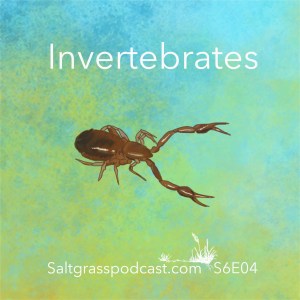
Meet the invertebrate team as we peel back bark, turn over rocks and shine lights on sheets to catch insects and arachnids out in the Australian desert.
One of the smallest teams on Desert Discovery they were looking at the some of the smallest critters, but they had their eyes open to all levels of life.
I call it un-civilisation. You get to see the stars out here, you know, the Milky Way, Scorpio and the Dark Emu…
Don’t worry about smelly clothes or smelly bodies. We all have them. Yeah, a great place to look and see and feel part of nature, get away from the city.
Links:
Australian National Insect Collection (ANIC)
Bevin’s book: A Field Guide to Eremophilas
Bevan’s iNaturalist profile
Mark’s iNaturalist profile
Australian Museum – Entomology
Transcript:
Ep 4 Invertebrates
Mark: Can you see it on the leaf?
Allie: Oh, it’s tiny. Oh my God. It’s so cute.
Mark: But this looks different. This one’s got black tip to its ends. So I think it’s a different species than what we found earlier.
Allie: Well, that’s a victory. Baby pseudoscorpion.
Mark: Well, it’s funny, after you’ve turned over and you don’t find any, you start thinking, are they actually here? Are they actually here? Or I say, I’ve lost my pseudoscorpion mojo. So it’s always nice to find one quite early on, gives you a bit of encouragement.
Saltgrass theme music and standard episode intro:
A couple of years ago, my partner and I drove three and a half thousand kilometers from our home in Castlemaine, Victoria, across the Nullarbor and into the remote deserts of Western Australia. Our destination was a place called Yeo Lake Nature Reserve to join a citizen science group called Desert Discovery.
For two weeks we camped with them and each day was an adventure to see what life is out there in the desert. A treasure hunt for rare and obscure species. I took along my sound recorder and went on a treasure hunt of my own for stories about who these people were and why they were doing this.
Season six of Saltgrass is still about salt of the earth people and grassroots change. It’s just a bit further from home.
You can hear all episodes of Saltgrass on your podcast app or at saltgrasspodcast.com. Saltgrass is produced on Djaara Country, home of the Dja Dja Wurrung. Yeo Lake Nature Reserve is on central desert country where the Yilka people, the Sullivan and Edwards families, and the Ngaanyatjarra and Nangaanya Ku peoples have walked for thousands of years.
Always was and always will be Aboriginal land.
Allie narrating: Nate and I arrived at the Desert Discovery camp on the 14th of August, 2022. The next day, on the 15th, I went out with the botany team, who you heard in episode two of this series. And then on my second day, on the 16th, I joined the entomology or invertebrates team.
Now, in this episode, there are a few words that sound a lot like other words, and I get the feeling I might need to clarify or explain the difference between some of these words. And the first is one of the names this team got called, which is entomology.
The etymology of the word entomology is from Greek, and it means the study of insects. And the Greek word for insect is entomon, so that itself means cut up, referring to the way that insects’ bodies are segmented. So entomology is the study of insects. But actually, the team was debating what name they should have over the course of the project because they also study arachnids, which are not insects – things like spiders, scorpions, and mites.
An alternative name for the team was the invertebrate team, so animals with no vertebra or spine, which covers both insects and arachnids, which all have exoskeletons.
The team was very small, with only three members, and the leader of the team is Bevan, who you have heard in previous episodes
Bevan: I’m Dr. Bevan Buirchell. I’m really a naturalist.
Allie narrating: Here’s another definition for you already, just in case anyone is a bit hazy. A naturalist is someone who observes, studies, and appreciates the natural world. In fact, the citizen science app we talked about in the previous episode, iNaturalist, has the tagline, ‘A community for naturalists’ And I’m just saying this in case anyone else had some confusion, because it’s very similar to a word that people use to describe nudists, which is naturists.
So for clarity, Bevan is a naturalist, not a naturist
Bevan: I retired about eight years ago and I spent a lot of time in the bush looking for plants and insects and stuff like that.
And so I’m a research associate at the WA Herbarium and I’m also a research associate at the West Australian Museum. So I spend my time, if you like, between plants and insects. I’ve become more interested in insects these days, and that’s what initiated my interest in getting Desert Discovery to have an invertebrate team.
I was originally on the botany team, and I recognized there was a deficiency of what Desert Discovery was doing. The last Desert Discovery that we were on, I brought out a PhD student. Who was from the University of New South Wales, Arlie McNay, and she was working on ant mimics, and so I took her out into the desert where lots of ant mimics live, and she collected a lot of those things.
So I just saw that Desert Discovery would benefit from having an invertebrate team. And so we’ve got three people here. Two of us have a little bit of knowledge. The other guy is good at writing things down and turning over rocks.
I met Mark through a mutual moth friend. That’s hard to say. And Mark has been contributing moths to iNaturalist, as well as collecting stuff to send to the Australian National Insect Collection (ANIC). So, I’ve known him from iNaturalist, as well as met him anyway, so I asked him along, his good expertise to come along. He always wants to go out in the bush, and he doesn’t have the opportunity, a four-wheel drive or anything like that, so that’s good.
Jeremy, not sure how I met Jeremy. Coffee group or a cycling group or something like that. Jeremy’s a biometrician, a statistician, but also does a lot of GIS work and vegetation mapping and stuff like that. So, I mean, he could have done all the fire mapping for this area before we’d come, if he’d known that that was needed. I have been out camping with Jeremy and his wife a couple of years ago, and so I said, “Oh, Jeremy, if you’re doing nothing, why don’t you come for a couple of weeks out in the bush with me?”
So he jumped at the idea. Yeah. And I’ve got him slaving away at turning over rocks and peeling bark and taking notes.
Allie: He’s a great enthusiast and generalist, isn’t he? He’s the one who saw the potential bilby mounds in the distance and was like, “Oh, that’s different. What’s that?” He’s just got his eyes open to everything.
Allie narrating: I’m just gonna interrupt myself for a minute here and explain Jeremy had a very exciting moment where we thought maybe we’d found some bilby mounds. The quest to find evidence of bilbies wove itself throughout the whole Desert Discovery trip. It’s a native marsupial that is listed as vulnerable across Australia, and it is listed as endangered in Queensland.
So to find evidence of them living there would have been really exciting. They would technically fall under the mammals and reptiles team remit, but the trapping methods for the mammals and reptiles team, as you’ll see in future episodes, is not suitable for bilbies.
The other way that they monitor animals in the environment is with movement-sensitive cameras that may or may not pick up things like bilbies. So the best way to know if bilbies are in the landscape is actually to look for their burrows, which are large and quite obvious if you see them.
The tracks and scats team, who we’ll also talk to in a future episode, they’re really good at finding the evidence of animals on the ground, even if not the actual animals. So they’re looking at burrows, scats that are left on the ground, and footprints. And Jeremy, one exciting day, found something that looked a bit like bilby burrows. He obviously wasn’t looking at insect level, he was looking at broad, general, landscape level patterns, we went over to investigate , and then it turned into a multi-day, multi-team, investigation into what it actually was and we will tell that story in the next episode.
Bevan: In his profession, he mostly looked at the ecology, if you like, from above, ’cause a lot of his stuff was about looking at satellite photographs and then making analysis on that. But he actually also liked to be on the ground looking at things and observing things.
I think out here observation is probably the prime thing that you need, the skill. It’s looking for that odd thing. I mean, if you look at the bush here, and you drive down the road, the bush looks the same. But if you really look, you’ll see the odd thing that looks out of place, and that’s the thing that attracts you. Like this little fungi that I picked up today. It was just sticking out of the soil.
That little white cap was sticking out of the sand dune. We’ve been told to keep an eye out for fungi. This looks like a little puffball.
Allie: How did you even know that’s a fungi? That’s amazing.
Bevan: Well, I dug it up. And it’s got a little stalk. And I’ll take it back to Mal, and he’ll be excited about it.
Allie narrating: All of the teams helped each other out, and if they found something that belonged to a different team, they’d report it back or share a GPS location so that the others could go and look at it.
But the entomology team, it was one of the smallest teams with only three people, but they really noticed everything. And maybe it’s because they had their eyes trained for the details of the smallness of what an insect is or an arachnid. But the team found, as you just heard, fungi for Mal, they reported birds back to the bird team. They would report tracks and scats and burrows and evidence of stick nest rats and all of the teams benefited from what the entomology or invertebrate team was observing.
And Bevan, I think, was key to that because he’s really knowledgeable both in plants and insects.
And then Jeremy, as you heard, is just a good observer, and that’s one of the key things you’ll find at Desert Discovery is you don’t have to have that in-depth knowledge. You can be really valuable, if you just have your eyes open.
Bevan: You gotta be a good observer of things. Well, an interest in, “Oh, that’s different. What is this?” And you go over and have a look and see what it is. It might be nothing. Or it might be a fungus, or it might be an insect trail or a camel.
I mean, on the way back yesterday from the loop drive, and when we got back onto the Anne Beadell, I stopped. There was camel tracks in the middle of the road, and I thought, “Hang on. We’ve driven up and down here. So that must be pretty fresh”. So we had a look at those. So it looked like a mother ’cause there was a little track as well, there was a calf there. We didn’t see the animal. But, I love looking at the tracks on sand dunes. It just shows there’s so much life on these things. You know, you’re out in the middle of the desert, but there’s things happening here all the time.
Allie narrating: Every day on Desert Discovery and with each team, there was a lot for me to learn about their methods, their equipment, and why they were doing what they were doing. And I loved the entomology team because they had some classic, almost cartoon-like equipment, like giant nets to catch butterflies in. And then Mark would stick his head right inside, so the net was hanging practically down to his waist, and he’d be in there trying to gently capture a moth or a butterfly or beetle or whatever they’d captured in the net. And then they also had odd equipment, like long tubes that they would suck animals off bushes and there was a capsule in the middle of the tube that then held whatever was sucked up the tube and stopped it from going all the way up into the person’s mouth. And they did a lot of thwacking of bushes, which they called beating, which would just disrupt, all the insects that were in the bush and make it easier for them to catch them because they’d all erupt and try and fly off, or they’d simply fall off.
Sound of bushes being beaten
Bevan: Don’t know whether you can see them. These little guys, they’re mirids.
Allie: What’s this contraption called?
Bevan: This is called a pooter.
Allie: A pooter?
Bevan: Yeah. Suck it up, and you got a filter here as well. So the animals go up the tube and stay inside the flask without going down your throat.
Allie: You don’t suck it down your own throat.
Jeremy: So was that off the cottonbush?
Bevan: Yeah, off this one here.
Allie: Oh, that’s beautiful, in flower, that cottonbush.
Bevan: You get more insects when things are flowering,
Allie narrating: So I hung out with the entomology team on my second day of Desert Discovery, and then followed a few other teams around, but I came back and sat with Bevan at his campsite and had a look at his process of pinning insects and documenting them and categorizing them and getting them ready to send to museums and things that would subsequently hold them and identify them more formally.
I asked him the sort of things they’d found out there, and I also asked him a little bit about his life and what had got him out here to Desert Discovery.
Bevan: So we’ve collected a fair amount of material considering how dry it is out here.
So most of the stuff we’ve got from under rocks and by peeling bark off eucalyptus trees. Normally we would catch a fair number of bugs that live on flowering plants. But obviously there’s not too many flowering plants out here.
All the flowering plants I have attacked with my beater and my net. And I’ve got a few things off, but not as much as we’ve got off bark. We’ve also got a really good moth collection as well. So, we put up moth lights at night and collect things off there. So, we’ll have a pretty good record of what’s around on this reserve, out of this initiative anyway.
So, the process that the team goes through is turning over rocks. If we see an insect or a spider or something of interest, we usually put it into a small container. And we take a note of whether we’ve got it under rocks or off eucalypt. And when we get back to the car, I’ll take a GPS reading of the locality.
And then we’ll allocate a number to each of the collections so that we can trace things back. Get back to where our camp’s set up, and then I’ll go through the process of either pinning them or the smaller stuff I put into alcohol so I can take it back to the museum and we usually mount them. So, they’re either pinned with smaller needles, or they are what’s called ‘pointing’, they’re glued to a tiny little piece of stiff paper.
So all of this stuff that I have in my little box here is the larger stuff that we’ve caught. So there’s two different grasshoppers, there’s some pentatomids, these guys, stink bugs, there’s a row of stink bugs here.
There’s the odd cockroach. And then there’s a various array of beetles. These little round ones are found under bark. They just sit there. They don’t seem to do anything except fall into the net. This guy here is a Scutellerid.
That’s a bit different from the pentatomids. And this is a crusader bug, this one. Because you can see the crusader marking on its back. We’ve got a beautiful wasp here, a lovely big wasp that somebody found. It was dead when they found it, but they’re pretty hard to catch and few and far between out here.
There are so many native wasps. Yeah, paper wasps are quite large.
And then there’s a whole heap of tiny little wasps, parasitic wasps, that go and lay their eggs in spiders and caterpillars and all sorts of things. And they play a significant role in the environment as well,
It’s good that this information is going to be used by DBCA, that they are going to use this information for the reserve itself. The stuff that I’ve collected will go back to the West Australia Museum as part of their collection. If there’s anything that is new and undescribed, that will then be made available to experts throughout Australia
There’s some pseudoscorpions there. Tiny little things that we’ve been catching under rocks and under bark from trees.
Allie narrating: Pseudo scorpions are what you heard Mark and I looking at right at the start of the episode. This is another term that’s worth explaining. They’re fake scorpions, they just look like scorpions. They’ve got these huge pinchers at the front of their body that look very ferocious but they don’t have the long tail of a scorpion that arches over their back and can sting things, they just have a little blunt tail. They’re generally really tiny, and they hide under rocks, so they’re quite hard to find unless you’re really looking for them. But they play a huge role in the ecosystem. They prey on the larvae of moths and beetles and ants and other mites. So if you ever see a tiny thing that looks like a scorpion but doesn’t have a long tail, it might be a pseudoscorpion. And they are really beneficial in that they keep all the other bug populations in check. So be nice to it if you see it.
Let it hide under a rock. It’s not doing any harm.
Bevan: I was amazed. I’d never seen a pseudoscorpion in the flesh before. I’d heard about them. It was real fun catching those.
Allie: And that’s part of why you brought Mark along. Is that because he’s a bit of a pseudoscorpion enthusiast?
Bevin: Well, I thought he was the moth enthusiast, but then I discovered that he’d done a lot, since he was a child actually, working on pseudoscorpions, so his presence has been fantastic.
His knowledge and how to find these things and catch them have been excellent. So I’ve been learning on the way. Picking up techniques, so having Mark Heath here with us, who’s, who’s done a lot of short range endemic catching – which pseudoscorpions are, short range endemics – it’s been very helpful for the group.
Allie narrating: Mark’s primary interest is in moths, and every night almost he was out there with a sheet strung up between trees and a light shining on the sheet to attract moths, and the light required a generator to run so I didn’t really talk to Mark about moths in front of that sheet much ’cause it was just a bit noisy. But I did chat to him about pseudoscorpions.
Allie: and so why do you have thIs particular interest in pseudoscorpions?
Mark: Well, it was interesting when I was a young kid, about 17, I was raising caterpillars.
And for caterpillars you have earth at the bottom, so they pupate. And then there was one day, out came this pseudoscorpion and I had never seen anything like it. So I brought it to my technician at the college and he spent about an hour and a half with me. Going through how you identify things, doing taxonomy, and we just worked through all the different groupings of things until we came across Pseudoscorpions, and I found that whole process just lit a fire in my mind I suppose.
Allie narrating: So Mark here is referring to something that people in the world of natural sciences will be really familiar with, but anyone who’s not had a training in that might vaguely remember it from high school. I certainly was very rusty on how the biological world has been conceptually divided up by science.
Every team in Desert Discovery did their own taxonomic work. So they spent time looking through books, references, asking each other questions to help identify what they’d found, be it plant, bird, animal, fungi or invertebrate. Trying to identify it as closely as possible to the specific species and if not to species, then to the next category up.
And I’ll do a little refresher course for you just in case you’ve forgotten, like I had, what all this is about.
The largest taxonomic division in the biological world is domain, and there are three categories of domain. One is bacteria, one is archaea, which are single-celled microorganisms that look very similar to bacteria. Some of them are extremophiles that can live in very harsh environments like deep sea vents and hot springs. And eukarya, and I hope I’m saying that right, I may not be, which is basically all the rest of life as we know. So that includes animals, plants, fungi.
Then we have kingdom. The kingdom that we belong to is Animalia. Plants are another kingdom, fungi is another kingdom, etcetera.
Then, you have Phylum. The animal kingdom, for example, is broken up into groups of phylum, like anthropoda, which is insects, spiders, crustaceans with exoskeletons, and chordata, which is organisms with a spinal cord.
So that includes all mammals, birds, reptiles, and such.
Within the phylum of Arthropoda, which is insects, spiders, et cetera, you have The class Arachnida, which is eight-legged things and excludes our three-legged insect friends. And then pseudoscorpions have their own order, which is the next category down. So they’re a distinct order from scorpions and spiders.
Then within the pseudoscorpion broad category, there are multiple families. There are 430, genus and 3,300 different species of pseudoscorpion that we know of. Which I think is quite a lot for something that you would never know was there unless you were turning over a lot of rocks. And obviously, because they’re so tiny and so well-hidden, there’s a lot of potential for more to be found.
And they can be found all over the world because Mark grew up in England.
Mark: And then fairly shortly afterwards when I was doing my A Levels we were able to do a project, very few people take that up, but I took it up and I did mine non pseudoscorpions and it enabled me to get to university. So I’m very thankful to pseudoscorpions. I feel I owe them a great deal.
My main interest has been moths, but I do find pseudoscorpions interesting and I still like looking for them. And it’s a group where you can easily find new species. Like there’s been times that I’ve put light traps out and pseudoscorpions have come onto the sheet and some of those that turn out to be new species.
Allie: The pseudoscorpions are attracted to light too?
Mark: You wouldn’t have expected that because they’re actually…
Allie: They’re under a rock.
Mark: They’re under a rock, and they actually don’t like light, but they do sometimes come to light. I think the point is that they know light attracts other insects, so therefore they go to it. Collembola, which are spring tails, that’s its main food source and mites. Ah. Now you see that to me looks very pseudoscorpiony, that size of rock. You want a rock, which is loosely sitting on the ground.
So come on, have a look. I want you to find one.
Allie: Well, if you found the one in a hundred, we’ve got another 99 to go.
Mark: Well, you see with four or five of us, we’ll do that quite easy.
Allie: Okay, 20 rocks each. So if you’ve got your hand spread out, it’s maybe the size of your hand. A rock that size.
Mark: Usually, although I find that’s the size of a rock it normally likes, but we have found them on smaller ones. Jeremy was quite ecstatic when he found his first one.
Allie: I bet. But now he’s found bilbies he’s gonna be a changed man.
Mark: Oh, and now he’s gotta stubble across a mallee fowl.
Allie: Oh yeah. Next quest.
Mark: It’s funny, I think secretly, some of us keep tally and we try to outscore each other.
Allie: How many things you’ve found in a day?
Mark: Especially to the pseudoscorpions. I found two. You found one that’s a bit of a friendly rivalry, I think.
Now see, when I see that, I get interested because pseudoscorpions make little huts. But not quite that big. And they make the huts ’cause the females then have they’re young in it.
Earlier that day, we’d been exploring a breakaway, which is an outcropping of rock looking for insects.
We had walked up the side a bit and found ourselves a nice little chain of caves. There was all sorts of indications of life. It was really interesting. Obviously a lot of animals were using it. There was lots of scat and lots of bones. And there were some insects and Mark had found some pseudoscorpions, which were so large, ginormous.
They were mammoth pseudoscorpions that he didn’t actually believe they were pseudoscorpions to begin with, but then he figured out that they were, they were just gigantic. They can be gigantic.
Allie: And by gigantic, what do you mean again? Three mil.
Mark: Oh no, these were
Allie: Ten mil.
Mark: Ten mil.
Allie: Ten whole millimeters.
Mark: I mean, I did not think it was a pseudoscorpion when I collected it in the tube.
Actually, I was doing what Bevan does. I pooted it and there was quite a lot of other things in there. Well, I pooted these large looking things. And then I looked at them thinking ‘what are they?’ I thought ‘wow, they’re pseudoscorpions’. I was actually shocked.
Allie: How big does studio scorpions get? Is like ten mil their maximum?
Mark: Oh, that’s a mammoth one.
Allie: They’re obviously found all around the world if they’re in England as well, when you were first learning about them?
Mark: Absolutely. You even get one which is found intertidally. So there’s a marine pseudoscorpion. So I think you’d find them everywhere in the world.
And the other cute thing about them is that they obviously can’t disperse well, but they’ve got this feature called phoresy. So if a fly just happens to land nearby, the pseudoscorpion latches onto his leg and hitches a ride. And that’s called phoresy.
Allie: And so then it could travel quite a long way.
Mark: Yeah. Then travels quite a long way. Now these look like interesting rocks.
Allie: So Bevan, were you already interested in pseudoscorpions or has Mark infected you with his enthusiasm?
Bevan: No, I knew about him before, but having Mark along who’s got the experience and in some ways a lifetime experience of catching pseudoscorpions. It’s been a nice education, actually.
And the fact that we actually caught them, ’cause, you know, I knew about lifting up rocks, et cetera, but actually it takes a bit of skill to recognize them.
Because they’re only tiny, tiny things. And once you see ’em and they move, then everybody gets enthusiastic about it. But they seem to be few and far between. This is worse than going fishing, actually.
Allie: It’s a lot more effort.
Bevan: A lot more effort. Up and down. Up and down. It’s good for your fitness, but yeah, you bou nce up and down.
Allie: Can you tell me a bit more about your professional history and your life, because it seems like no matter what topic comes up, people say, ‘Oh, Bevan will know about that’. So you’ve obviously got this wide breadth of knowledge and a lot of different experiences.
Bevin: I’ve covered a lot of fields professionally. So I’ve got a PhD in biochemistry. I’ve worked for a while in the medical area. And then moved into agriculture. So I’ve spent most of my professional life working as a plant breeder in the Department of Agriculture in Western Australia.
The national lupin breeder I ended up. And currently all the varieties that the farmers are growing out there at the moment are all ones that I’ve brought up from children if you like. So, I feel very proud driving through the agricultural areas and seeing these things growing.
But I’ve always had a liking for the bush, I’m a country lad, so I used to spend a lot of time out in the bush collecting orchids and all sorts of things.
In some ways I’ve had a professional life and I’ve had hobbies and my hobbies have been, to begin with, around botany. I took a great interest in orchids and did a lot of work in orchids and then moved on to more desert plants, particularly eremophilas, which are an endemic Australian desert plant. Something like 85 percent of those grow in Western Australia.
A friend and I decided at one stage that we would write a book, A Field Guide to Eremophilas, and that was in 1997. But first of all we had to actually understand the whole genus. So, we did a lot of travelling in the outback. That’s partly why I know a lot of the roads out here. I’ve been down nearly every track there is, except for up in the Great Sandy Desert in the north. I need to get in there to have a look.
But yeah, looking for new ones, looking for old ones, trying to understand distributions and that sort of stuff. The ecology of the whole thing, and trying to understand where they fit into the environment and the role that they play. We wrote a whole book on it, and we found a whole heap of new ones. You know, we’ve probably found about 40 new ones, undescribed, new to western knowledge, if you like.
I’ve described about 16 different species so far. Gave them official names and had them officially published. Got about another 20 to go. I’ve got some papers in draft form, I’ll work my way through it.
I, at one stage, decided that in my plant breeding work, we were using DNA technologies in a breeding program and I thought, ‘oh, this would be great to apply to eremophilas’. Just to have a look at the phylogeny, the relationship between all the eremophila groups, et cetera.
And then I heard about a PhD scholarship that was being offered out the University of Melbourne. And so I contacted the person, Mike Bailey, and offered my expertise and willingness to take his student out in the bush. And I’ve done that. But, there was another scholarship as well, through the University of New South Wales, that was to look at the insects that live on the Eremophilus. So, I was asked to take that student, Sean Cullerton, out in the bush as well. So we did joint trips with those two PhD students.
I think I went on about three trips. We did about 15, 000 kilometers or something in the bush. It was a great opportunity for them. I mean, they wouldn’t have been able to actually complete their PhDs without them having field work to collect insects. Sean collected heaps of stuff. And I became interested in what he was doing, you know, how he was collecting things, how excited he was about insects, etc. So I started collecting for him. Whenever I was out in the bush somewhere and I saw an eremophila, I would collect it and send him the insects.
So that’s sort of how I started to get involved in insects.
I’ve been out in the bush with his supervisor and with the head of the insect collection from the West Australian Museum. And so now I do a little bit of collaboration with those two people. So, I’ve turned hobbies, if you like, into genuine interests.
Allie: Can you tell me, how did you find out about Desert Discovery and what were your first few experiences like?
Bevin: I’m not quite sure… I do know an original member. In fact I have coffee with him just about every Tuesday. And he may have mentioned it at some point. Then I knew through my agricultural days, Alan Bedggood and Marie Goods as well. So I contacted them and they said, ‘yeah, come along’.
This is my third one. The first one was Kiwirrkurra, which was just fantastic. I fell in love with the Desert Discovery Group and the ideal of going out and doing a biological survey. And also the opportunity to go to places where a lot of people wouldn’t get to.
So the Kiwirrkurra trip was just fantastic. The next one was out the Gunbarrel Highway, the Eagle Highway. I’d been out there before, but not up to where we eventually had our camps. And there was the opportunity to get into other places wouldn’t have got into by myself, so that’s good.
It’s good to be with other people when you’re tripping around out here, for safety’s sake. If you have like-interested people, lots of eyes, you see lots of things. Whereas one pair of eyes you’re only seeing a small amount of things.
I call it un-civilisation. And you get to see the stars out here, you know, the Milky Way and the Scorpio and the Dark Emu and other things like that.
Don’t worry about smelly clothes or smelly bodies. We all have them. Yeah, a great place to look and see and feel part of nature, actually, get away from the city. I feel much more relaxed and at home out here than in the city. It just feels so unnatural. Whereas out here it feels part of the whole thing.
Allie: You’ve got a great set up for hitting the road and being relatively comfortable out here.
Bevan: Just a little camper trailer. So it has a nice comfortable double bed. It’s got plenty of storage underneath for my clothes and equipment and a couple of bins on the front for storing other things that you need. And a little kitchen, a pull out kitchen that’s got a three burner stove. Carries 120 litres of water. I can carry fuel on the front. It pulls behind the car really easy, I don’t even know it’s there. I’ve had this for eight or nine years. Must have done a hundred thousand k’s by now, I reckon, at least. You know, it’s been up to Birdsville and you name it, that’s where it’s been… across the Nullarbor.
Allie: I’m a first time Outback visitor. I’ve never been to the desert. I’ve never been to WA before this trip.
Bevan: What?!?
Allie: (laughs) I know. A lot of the people here are really experienced travellers. And it’s amazing to me how much there is to know that people who are really comfortable with it don’t even think to say. But, there’s a lot to it, isn’t there? To do it safely and to be wise.
Bevan: You need to have a reasonable vehicle that’s well serviced. You need to have good tyres. Don’t come out here with bald tyres and street tyres, that sort of stuff. You need to have good tyres. You need to learn to lower your pressure on your tyres when you come out here, not to have you know highway pressures etc. Because you’re banging over corrugations and if you lower your tyres down to 30 psi then gives you a smoother ride and the corrugation is causing problems to your suspension as well. And it’s also better for not creating those bigger corrugations because hard tyres, hard suspensions just keep building the bumps up, etc. Make the track worse.
Give yourself plenty of time. I mean a lot of people unfortunately come out to these places for a week’s holiday and they’ve got to travel fast. It’s a place you just gotta cruise along and look. And as I said, a lot of the country looks the same, but you can always pick up differences. Different vegetation, different hills. Take an interest in the birds. Birds are wonderful. Plants. And you’ll see different animals out here if you do it quietly. Don’t bring your radios. Just listen to the environment. It’s wonderful listening to the wind blowing through the mulgas.
When people think of desert they think of the Sahara, okay, just sand, sand, sand. The deserts in Western Australia and across into South Australia – highly vegetated, quite a diversity of plants which supports a diversity of animals, a diversity of birds, diversity of insects, obviously.
So there’s lots of things to see out here. All those little animals that are around as well, although they’re under pressure from cats, et cetera, are still holding out out here, and they’re the things that are worth seeing.
No, no, it’s paradise out here. I may say so myself. But you come to appreciate what it is after a while.
It takes a little while. If you go out with somebody with a little bit more experience, you know, like coming out with Desert Discovery for yourself, people point out things that you would have been oblivious to. You start to appreciate what’s here.
Allie: Absolutely true. And going out with different teams, I’ve been out with your team a couple of times, and with the botany team, and with the mammals and reptiles team, you’re all looking at different things, each team you put a different set of eyes on, there’s just so much happening. It’s amazing.
Bevin: All little parts of the ecology that’s out here. It’s difficult to look at everything. And if you look at little bits of it, you get a better appreciation of what’s happening, but then when other groups are looking at other parts of that and then you all come together and put it together, then you start to get a larger appreciation of what’s in the desert.
How resilient the plants and the animals are out here and the birds. They’re adapted to the really bad times as well as the good times. So, their biology, you know, you get rain through here, things will just proliferate. In the desert that’s what you have to do. You’ve got to be opportunistic.
In lots of ways, appreciate what the Aboriginals have known for a long time, and have looked after. I mean really that’s the things that I look forward to, seeing those things that other people have seen as well, but have appreciated in a different way.
And we need to look after it. We need to do things to make sure that it’s still here when we leave. We need to look after these plants and animals. We need to feel in some ways similar to what the aboriginals do, a part of the country. Or the country’s part of us, when we’re a part of the country, simultaneously, rather than the lords of the country, and the managers, etc. Without the things in our environment, we don’t exist. We can’t exist by ourselves. All these other things are part of what we are as well. Or we are part of what they are. And to get out of the cities, that’s the only way to appreciate those things.
Theme music and outro
I hope you enjoyed this episode. Links and notes about the show are on the episode page on the saltgrass website, saltgrasspodcast.com. Don’t forget to get your Saltgrass ethical t-shirts, tracksuit pants, and hoodies, and there is a new range created specifically for this season with lots of designs based around the animals and plants that were found out on this Desert Discovery trip.
There’s a link for the merch front and center on the Saltgrass website. Again, that. saltgrasspodcast.com or go to the merch page on the website and see the full range of Saltgrass gear. For those of you listening on the radio, please note that you can listen to all episodes of Saltgrass on your preferred podcasting app or at saltgrasspodcast.com.
You can follow us on the socials and you can subscribe to our email list to get reminders and updates about the show. The music this season is from a song called Great Divide by the Split Peas.
(Singing)
This program was made possible with support from MainFM and the Community Broadcasting Foundation. Find out more at cbf.org au.
My name is Allie Hanly. Thanks for listening.
Allie: Oh. Oh, I just had a big fly land on me. Are you catching flies?
