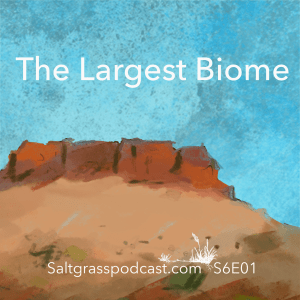
Australia is the driest inhabited continent on earth. The majority of people live in the major cities that hug the coast line, and as much as Australia is famous for the ‘red centre’, many Australians have never been.
This season Allie, Saltgrass’ host, will take listeners on an adventure to a remote desert location in Western Australia with citizen science group Desert Discovery. This first episode is just the beginning, setting the scene and introducing you to the first of many colourful characters.
Transcript:
Nate’s First Desert Sunset
Nate:
My first evening was beautiful to me. There weren’t many clouds in the sky, but it was a very, very pretty sunset that set behind the range, which was not even half a kilometer away. So just there. And as the sun dipped down, it just happened to be a full moon that night, which came up on the opposite side. So I just had to turn around. And so yeah, this big, beautiful full yellow moon came up over the horizon, still in twilight, so lots of purples and a little bit of orange and fading into a deeper blue above. And yeah, it was, just magical to me. And that was one of those moments. It was a unique experience. The desert had got its claws into me then I think. Yeah.
Saltgrass theme music and standard episode intro
Allie narrating:
A couple of years ago, my partner and I drove three and a half thousand kilometers from our home in Castlemaine, Victoria, across the Nabor and into the remote deserts of Western Australia. Our destination was a place called Yeo Lake Nature Reserve to join a citizen science group called Desert Discovery.
For two weeks, we camped with them and each day was an adventure to see what life is out there in the desert. A treasure hunt for rare and obscure species. I took along my sound recorder and went on a treasure hunt of my own for stories about who these people were and why they were doing this. Season six of Saltgrass is still about salt of the earth people and grassroots change. It’s just a bit further from home.
You can hear all episodes of Saltgrass on your podcast app or at saltgrasspodcast.com. Saltgrass is produced on Djaara Country, home of the Dja Dja Wurrung. Yeo Lake Nature Reserve is on the country where the Ngangatjarra, Mandjindja, and Tjalkanti people have walked for thousands of years.
On this trip, we crossed the lands of many Aboriginal people. I pay respects to elders past and present. Always was and always will be Aboriginal land.
Intro to the episode and season
Allie narrating:
Welcome to a new season of Salt Grass.
This whole season’s gonna be looking at deserts in Australia and this group that I’ve gotten to know called Desert Discovery. Every two years, people from around Australia and in fact from around the world come together at a carefully selected site in the Australian Outback, and they spend a couple of weeks systematically surveying the ecosystem. That simply means counting and identifying as many species of plant, animal, and fungal life as they can.
They’re all volunteers and many have a lifetime of experience behind them in ecology, science, zoology, biology, or some other specialty of the natural world.
Desert Discovery is a not-for-profit group that organizes the trip, the location, the permits, the infrastructure and logistics of setting up a camp for all of those people. All of the data collected is shared freely with universities and museums, adding valuable information to humanity’s collective knowledge base about very remote locations in Australian deserts that have previously been largely unobserved by Western science.
Me going along with them on a project a couple of years ago was mostly personal. Nate, who you heard at the top of the episode, was my partner at the time, and he was a dedicated Desert Discovery member. But also I was deeply curious about what this group did and what it was all about. So I went along on a project in 2022 and I took my sound recorder just in case there was anything that might work out for Saltgrass.
Turns out there was heaps.
I spent every day of the project following groups around and talking to people about their lives, their work, and what they were looking for out there in the desert. I came back with so much audio and video recordings that I’ve had a really hard time working out what to include and in what order to put it all in.
So stay tuned. Each episode of this season, we’ll talk to different people who are on the trip and it will be part travelogue, as I share what my experience was of going on the trip, part education about desert plants, animals, and fungi, and part exploration of how citizen science works and who the people are who participate in it. We explore the benefits and limitations of citizen science and look at some of the methods and systems used. We discuss the ecological value of such remote and seemingly inhospitable landscapes.
For this first episode, I’m gonna share with you a bit of context, including what a desert even is. Then we talk to Nate about how he got involved in the group, and we’ll meet Colleen, who is the Secretary of Desert Discovery, or DD, as everyone calls it. She was also an important part of Nate’s connection to the group.
We’re gonna talk about what it takes to prepare for a trip like this, where it takes a week of solid driving just to get there, and then you’re camping for several weeks far from shops, electricity or any medical aid should you need it.
When I jumped in the car with Nate at the start of the trip, I didn’t know what it would all be like. I didn’t know the group very well or the things they did, or about camping remotely or traveling on corrugated roads in the Outback. It was all new to me, and I imagine that for many listeners, it’s all new to you too.
Most of the people I interview in this series are very experienced, both in their knowledge of the plants and animals that they were looking at and in moving through the desert.
But, the thing to note about Desert Discovery is that it’s full of people who are very passionate and very knowledgeable about very particular things, but that doesn’t mean that they know everything about everything. And there was a wonderful spirit of curiosity and inquiry.
So for example, there were three people on the trip who had written books on a type of plant called an eremophila. I quickly learnt that although we had no internet out there, we did have an incredible resource in the people. Instead of googling ‘what does eremophila mean?’ I could ask. And I found out that it means ‘desert loving’ and it’s a huge range of plants found right across Australia, which thrive in arid environments.
I loved the culture of openness and sharing in the group, and the curiosity they each had for each other’s expertise. No one, no matter how much they already knew in their field, was afraid to say ‘what does that mean?’ to someone.
And it was so great!
So as we go along, I’ll do my best to anticipate and explain things that I think might be new information for listeners. But don’t be afraid to Google things that I fail to explain properly because you know, we can’t all be experts on arachnids that look like scorpions that live under rocks in the desert. We’re gonna get to them later, don’t worry.
For those of you listening who are familiar with botanical and zoological terminology, please be patient while I explain for other people, and if I get anything wrong, especially pronunciation, which let’s be honest, is highly likely, then I apologize in advance. It’s also worth noting that there were quite a few conversations out in the field amongst people who are experts in this stuff about how to pronounce things, and there was disagreement sometimes. So it’s not necessarily, ‘one solution is the correct solution’ kind of problem.
I spent some time in America when I was younger and I came back with a list of words that I love saying the way Americans say them. Like we say oregAno and they say orEgano. And it’s just a different emphasis.
In this and coming episodes, I’m gonna explain what Desert Discovery is as a group and how it all started. We are gonna talk to some long term members who’ve seen it change shape and direction over the years, and talk to current participants about what attracted them to the group, and what keeps them coming back.
I’m gonna go through a little bit about what it’s like to drive over there, the distances, the remoteness, the weather.
Almost everyone I spoke to had a story about someone else who had been an inspiration and a positive influence on them. A mentor. I hadn’t expected so much heartwarming discussion about mentors and age being just a number and there were so many very interesting people on the trip whose origin stories, I really wanted to find out about.
It’s a group that finds new members cautiously. So with each person I asked, how did you come to be here? How did you find DD? And often it’s a story that’s a convoluted tale of connections. People will be mentioned as part of other people’s stories and I won’t be able to introduce everyone to you all at once. So go with the flow and keep your ears open because most of the names that keep popping up, we’ll be eventually introduce to you properly.
So first I thought you might like to talk about what a desert even is and what the desert means in Australia. There’s just so many, different deserts in the world.
Discovering Deserts
When you think of a desert, what do you think of? Is it like the Sahara or Arabian deserts with giant sand dunes, camels, and perhaps the rare relief of an oasis?
Or is it maybe flat and dry and dusty with tall cactus and pillars of rock jutting into the sky, gorges and ravines and tumbleweeds. The kind we’ve seen in the American movies about the Wild West.
I wonder if you know what the Australian desert is like? You might have images from Crocodile Dundee, Priscilla Queen of the Desert, Mad Max.
I know that before I went on this trip, I didn’t really know what the desert was gonna be like. I had lots of images in my mind and lots of ideas about what it might be like, but I didn’t really know.
At the start of the episode, we heard Nate talk about his first experience of being out in the desert and the beauty of a sunset that he saw, which really captured him. You’re gonna hear his voice through this episode and future episodes. He was my introduction to the desert, how to exist in the desert, and also how to appreciate it.
Nate:
What I tell people about the desert, it’s full of interest.
Every rise you go over there’s something else. It changes constantly. If your eyes are open, you know, if you’re willing to look at the environment with fresh eyes, actually it’s incredibly rich. The desert just means that the rain doesn’t fall much.
That’s about all it means, but there are plants and fungi and mammals and reptiles and birds and insects that have just learnt to adapt to that. So what I found on that first trip was that there’s more natural, almost unchanged biodiversity per hectare out there than there is in my own backyard.
Yeah, it was rich once, the East Coast, but we’ve degraded it so much and the desert is relatively speaking, unchanged.
Allie narrating:
The great Australian desert is the fifth largest desert in the world. It ranks fifth in size after, and this is in order, Antarctica, the Arctic, the Sahara, and the Arabian Deserts, two of those five aren’t even hot.
The poles are classified as deserts because it’s too cold to rain, it gets snow instead. And if you look at Google Earth, the other two are kind of the same desert with the Red Sea cutting through. The Great Australian Desert is actually made of many interconnected desert ecosystems stretching from the coast of Western Australia, right through the center of the continent until it butts into the Murray-Darling Basin and the Great Dividing Range on the east coast.
Ruby:
Most of Australia is desert, like it is our largest biome by far.
Allie narrating:
This is Ruby, a university student who was able to come on the 2022 Desert Discovery Project with me and Nate talking about the desert.
Ruby:
It’s nice to come out and see for myself things flowering in desert country. Desert communities can flower at any time of year ’cause it’s really dependent on unpredictable rainfall. So the rain can come across the landscape at any time of year and everything will respond basically.
Allie:
Yeah. Right. So it’s not as though it’s seasonal. It’s not like winter, spring, summer. Or even the six seasons that our local indigenous people have in Castlemaine. It’s more just like the rain comes, everything goes okay now.
Ruby:
Yeah. I mean, even now out here, it hasn’t rained for quite a while and there are still things flowering. So there’s some sort of shrubs and stuff that have deeper root systems and more resources to flower. But the community overall. Things that occur out in these areas. There’s a lot of opportunists. Yeah. You’ve gotta be opportunistic to make it basically in such an unpredictable landscape. Yeah. So it’s nice to see that firsthand.
And to see the bees. So many bees visiting flowers. I’ve seen three species and I’ve been told of another one. But I’m not, I’m not a bee taxonomist. I’m just a bee enthusiast.
It’s great to see that there’s still, even when it’s this dry, there’s still stuff flowering and there’s still bees visiting the flowers and getting stuff out of them.
The Desert in Australia
Allie narrating:
As Ruby just said, the desert is Australia’s largest biome, or ecosystem, with about 18% of Australia classified as desert. That’s almost one fifth of the continent. But if you include arid and semi arid region, that jumps up to 70% of the Australian mainland.
Australia is the driest, inhabited continent on earth and our deserts can be like all of those classic images of deserts, it’s quite varied.
We do actually have 30 meter high sand dunes, notably in the Simpson Desert, which sits at the intersection of South Australia, Queensland, and the Northern Territory.
We have wild though, not native camels and we also have grasses, which can form tumbleweed like wheels that float across the ground, driven by the wind. And I love what that plant is called. It’s called Hairy panic. We have ravines and gorges and amazing rock formations that have withstood millions of years of erosion. Uluru is the most famous, of course, with the Olgas or Kata Tju ta, just down the road.
So yes, we have some of those classic desert features. We also have a lot of red earth, and that’s because there’s a lot of iron in the soil and the iron is rusty, and that’s why it’s red. We also have a lot of salt and ephemeral salt lakes, so they only fill up every now and then. Most of the time it’s really dry, hard baked, but when it rains, those lakes fill up. There’s also heaps and heaps of flat, dusty land with shrubs and trees and rutted, dirt highways that crisscross through the nation. Corrugated roads, which will wreck havoc on your vehicle if you’re not careful.
When tourists and travelers and people from other countries think of Australia, they often think of the outback, the red center. It’s either that or sunny beaches and surfing.
Yet, only 3% of Australians live in the desert, and many Australians have never been. In fact, 87% of Australia’s population lives within 50 kilometers of the coast, and most of that 87% live in the major cities. Until recently, I had never been. Like many Australians, I dreamt of taking that big trip one day, doing The Big Lap, or going into the red center and up to Kakadu, you know, the famous stuff. But I’d never gotten around to actually doing it. And like most Aussies, I have traveled to Southeast Asia a couple of times. I’ve been to Europe and America, but I’d never ventured into that vast interior of my own country.
That all changed when I met Nate at work. He was a member of a citizen science group called Desert Discovery. Every two years, he disappeared from work for a month or more and went deep inland to extremely remote and hard to access country with the group. He came back from these trips with intriguing stories of animals and landscapes and fascinating people. Long before we started dating, I asked if I could go on one of the trips with him and he’d been keen. He was happy to help anyone get involved with Desert Discovery ’cause he was really passionate about the group and what they did.
And I would quiz him in our lunch break and find out more about what they were doing and daydream about going. But once we got together, it was suddenly not just talk, but a very real prospect. I was almost obliged to go now that we were dating.
The next desert discovery trip or project was due to happen in 2020. You all know what happened in 2020.
So, due to the pandemic, there was no Desert Discovery project that year or the year after, but there was a lot of hopeful planning and then rescheduling and then planning again. And I heard all about it ’cause Nate was on the committee of management.
Finally in 2022, it looked like the project was really gonna go ahead. The vaccines had been widely administered, and though COVID was still tearing around the planet and changing shape and continuing to cause havoc, travel restrictions had largely been lifted. Desert Discovery, or DD as it’s known by most of its members, was planning to go to a place in Western Australia called Yeo Lake Nature Reserve, and it looked like I was gonna go too.
The Desert and Climate Change
I guess I should say also that this season of Saltgrass is not gonna talk explicitly about climate change as much as maybe the usual episodes of Saltgrass do. It does come up, of course, but the emphasis is more about the wonders of the desert ecosystems and the joys and challenges of citizen science.
But I do wanna point out that part of my interest in the desert ecosystems is to understand how life can survive in hot, dry, seemingly hostile environments. A couple of previous episodes of Saltgrass, I’m thinking about the episodes with Connecting Country, have looked at how we can start preparing our local ecosystems by introducing varieties of plants that have adapted to harsher climates. Climate’s a bit closer to the equator that already reflect what our climate is predicted to become as climate change progresses. So for example, Castlemaine the projections for this region are that it will become hotter and drier and that we will have rain events further apart, but each one will perhaps dump more water so we might get more floods.
It has been suggested that Castlemaine will become more like Dubbo, which is a couple of hundred Ks north of us in Central New South Wales. The CSIRO has done a lot of work on this, and I’ll put a link in the episode description.
The flip side of this strategizing about adaptation is that deserts are already some of the hottest and driest places on the planet. So there are not many examples of places that are more extreme than that. Life in the Australian desert has had a long time to evolve ingenious solutions to the heat and lack of water by all levels of life. You’ll hear through the following episodes how different species have achieved that and also how introduced species are disrupting an often precarious balance.
But for all the wonders of their adaptations, it may not be enough. When climate change comes to the desert, the desert species may thrive in the future if they can move to places that have not been deserts so far, but which will become deserts. So their range or location might change, but what is currently desert will probably become uninhabitable by most species, even species adapted to extreme heat.
We’ve already seen temperatures over 50 degrees celsius in Australia, and as is the case everywhere, these climatic changes are happening way too fast for evolution and natural adaptation processes to keep up.
So I’m fascinated by the desert ecosystems as it shows the amazing ability of life to find a way. But keep in mind that just because something has evolved to survive in the deserts, that doesn’t mean that they’ll be able to adapt quickly enough to survive the extremes that climate change will bring. If you want a sobering read about how different species are already adapting to climate change all around the world and what limitations they’re already encountering, I have put a link in the show notes to an article in The Conversation. I found it a really good explainer on this topic, so yeah, I’ll link to that.
Getting ready to go
So Nate warmed me up to the idea of going to the desert with a couple of trips within Victoria. And I guess, to test out whether we would travel well together, whether I would enjoy the kind of people and places that he really loved going to.
He took me to a place called Ned’s Corner. It’s right up in the northwestern corner of the state of Victoria where we live, and it is in a very dry, arid landscape. But it’s right on the Murray River, which is a huge beautiful water body that captures the snow and rain from the east coast and winds its way all the way across through to Adelaide and releases out into the Great Australian Bite. And the river is just gorgeous and some of the trees up there are so huge river red gums that must be so old. Ned’s corner, it was an old sheep property managed for a while now by Trust For Nature. And Trust For Nature is an amazing organization that helps people put a covenant on their land to preserve it through time. Nate told me all about how it’s a conservation property they’re rehabilitating it and they’re trialing different plants and trying to encourage native animals to come back and inhabit it and so they’re testing for that stuff.
I met Colleen and Peter who were the managers of the property, and also Desert Discovery members. And you’re gonna hear the name Clive Crouch pop up, his name’s gonna pop up across many episodes. He’s one of these people he’s been instrumental in so many people finding and joining Desert Discovery.
Colleen:
We went out as managers of Ned’s Corner in 2008. Met Clive who was a volunteer for Trust for Nature. He started talking about Desert Discovery, reckoned that we would be valuable going with him as one of his students, I suppose. He was our mentor with the mammals and reptiles. So our first trip was 2010 with him to Sykes Bluff, which was an eye opener. Highways definitely aren’t highways. We went down the Connie Sue Highway, the brush was up against your car, scratched your car. Beautiful countryside with the breakaways, and the jump ups, and the gorges, and it was absolutely stunning.
My interpretation of a desert was just sand dust, and you get these gorgeous woodlands and all this stuff all through these deserts.
So. A bit of an eye opener. Yeah. Ned’s is a floodplain mostly, probably 28,000 hectares would be a floodplain. The rest would be just a sand dune around the edge, bit of river country. So expecting the desert to look worse than what Ned’s did, and it doesn’t, it’s just absolutely beautiful.
So started our love for the remoteness, I suppose, and being on this is our sixth Desert Discovery in 12 years, so.
Nate:
So I was studying conservation Land management with Bendigo Tafe. There was four major components for that, one of which was a research project. The other was a biological survey. So we were going up to Ned’s to do the biological survey part, which includes mammals and reptiles, but also birds and plants. And for my research project, I got onto another Trust For Nature employee who asked me to do some vegetation and soil mapping at Ned’s Corner. So I tacked that onto the biological survey trip, which was, I think we’re only there for a week or two, and I tacked another two, two or three weeks onto that. I went up before, didn’t have a car, so brought my bike.
Allie:
Like your push bike?
Nate:
Yeah.
Colleen:
And we didn’t have a spare car to give him. And a like. How does he get around? Well, he’d probably bring his push bike. I’m like, what?
Nate:
It worked.
Colleen:
He goes treading out there. I reckon you did about, I know you would’ve been probably three Ks away from the house. Maybe five.
Nate:
Yeah, I got at least three Ks out. I know that. ’cause I was halfway to Dead Tree and that’s six Ks
So yeah, doing what’s called a Quadrat survey. Which is basically a square and you just name all the plants that are in it and took soil samples. So it was mapping the correlation between the plants and the soil types.
Colleen:
You did a fair bit of finding out what the dead trees, the stumps were too, didn’t you?
Nate:
Yeah. Well that was the result of that research.
So Ned’s Corner sits on what’s called the Murray Scroll Belt, which is a very unique ecological community and landform. It’s where the Murray used to flow. So there’s a big floodplain next to the Murray and it just carved its way through there for thousands of years.
Allie narrating:
This conversation was recorded out on DD out at Yeo Lake, and we were standing near the one water source that was on site when we arrived, which is a pump. It’s an old fashioned hand crank pump where you lever up and down this piece of timber and it gradually pumps up some water for you from a bore and the groundwater below.
It was the only fresh water on the whole property. And we did bring in, a lot of water as well to support our stay there. But, just as we were talking, a guy called Mal came up with a bucket hoping to get some water for his campsite.
Allie:
It’s good timing for water though, because we’re talking about the Murray.
Nate:
If you listen closely, you can hear it in the background. (Laughter)
Mal:
I’ll get outta your road now.
Allie:
Thanks Mal.
Nate:
So as the river flows through and calves its way through the land, it gets cut off. It creates what they call billabongs or oxbow lakes. And they stay like that for a while with water in them and eventually they get filled in with clay and at Ned’s Corner you get these circular bands of clay pan with what used to be low sand dunes in between.
So before white man came and trashed the joint with their stock and cutting down the trees to make fence posts and that sort of thing, there were all these sand dunes right across this floodplain. And so my research was trying to pick out to see if there was a correlation between the plants that exist now and the soil. And from that, someone else could tell what vegetation communities used to be there. And so now they’re working to try and restore those. So there would’ve been, what do you call it, Cyprus Pine, which Cyprus Spine.
Colleen:
Callitris
Nate:
Yeah, Callitris, so native conifer. It would’ve been growing on these dunes as well as other plants.
Allie:
And we’ve seen some of that out here. Those callitris growing in dunes.
Nate:
Yeah. So they’re up here as well. A lot of the plants and landforms out here are quite like what’s on Ned’s. It’s the only place in Victoria where this kind of community exists, right on that southeastern edge of desert country.
I was designated team leader for my TAFE group. I was up there early, so I had a couple of days with Clive and we went out and had a look at sites .
Very knowledgeable, down to earth man. Very generous with his time and knowledge. They were my first impressions. We got on pretty well, and I think he liked the way I ran the survey even though I’d never done it before. And after that he invited me back to Ned’s and other places to do other fauna surveys, and then eventually he invited me on DD and that’s where I got started.
Nate’s first Desert Discovery trip
Allie narrating:
I asked Nate to describe his first trip with Desert Discovery and he was fortunate to travel in convoy with Clive and have Clive as a mentor .
Nate:
So I was pretty raw, really. I had no ID skills. I left all that up to Clive. It was a really pleasant trip in that way ’cause I didn’t have to think too much. I just had to get myself there, make sure I had enough food and water and that was about it. I was just along for the ride. It was great.
Distinctly remember the drive up because once you get past Port Augusta, the landscape just changes. For someone who’s lived on the East Coast, I’ve done a bit of travel, but really up and down the coast and the mountains. So Queensland, new South Wales and Tasmania and Victoria a lot.
Once you get past Port Augusta, it’s completely different. Yeah. I dunno how to describe it, but I just, I remember thoroughly enjoying the drive the center’s got this reputation for being a bit monotonous and boring and it’s so not,
Unbeknownst to me, Clive had invited a few of us along in the hopes that one of us would take over his role as the team leader.
And so yeah, when he said, I’m not going next time, which was a little way down the track, I was recruited.
So my second project and the first one where I had the responsibility of coordinating a survey, you know, I had a lot of help. It wasn’t too arduous. Applying for permits was relatively straightforward.
I really just had to do that and get all the equipment there, and there were people to help with that.
So after the first trip, I decided that the Suzuki probably wouldn’t make another trip. The first trip sort of beat it up a little bit and I needed more space, especially if I was gonna carry the equipment needed for the survey.
So some of my wonderful friends lent me their troop carrier. We just did a car swap basically, and that was wonderful that, but geez, troop carrier you could sleep in the back. Big roof rack, which had a ladder up to it and it just fit heaps of stuff on and it was great.
So before the next trip, I decided I needed a new car, which would do the job, and so that’s the one I’ve got now.
Allie narrating:
We are gonna indulge in a little bit of car talk, it is a topic that everyone spoke about all the time because your vehicle is, basically your life out there. It gets you in and out safely, and if it breaks, you’re in really big trouble. So everyone talks about and thinks about their vehicles a lot, and . Everyone has a different setup. And so everyone’s comparing notes and talking about whether, you know, a camper trailer is a really good way to travel or just bring a tent and pitch it, or just sleep in your car like some people did. everyone just had a different setup and different reasons for having a different setup.
So vehicle upgrades and vehicle modifications were, , of high interest in the Desert Discovery Camp.
Nate:
I bought an aluminum canopy, which is basically a tradies canopy with three compartments, two go wing doors, and then a door at the back. For the center compartment, which has a slide on it that’s got my fridge, it’s also got a fairly large roof rack and that all sits on my existing aluminum tray, which I’ve never been convinced was enough, but it’s done the job so far.
But that itself weighs over 300 kilos, which is a lot more than what I had on the back previously. So that necessitates a suspension upgrade. Which is just enough for when I have a full load. And with that canopy, I’ve then put what’s effectively a third battery in the back to run the fridge and some lights and power our devices.
I’ve put some Jerry can holders on the back, made a few little modifications, which all, all takes time and effort. But I’ve set it up now so that I can pull this canopy off and just whack it straight on my next car. When this one gets a bit long in the tooth or gets a problem, that is too hard to fix.
You know, cars are like, this car has done me very well. I think I’ll get at least one more trip out of it, if not more. Yeah, it’s been good.
Allie narrating:
The whole time Nate and I were dating, I watched him gradually improve his vehicle and make all those modifications he was just talking about. And by the time it came round to the 2022 trip, he was feeling pretty ready. And I do suspect some of the conveniences, like a fridge that runs on electricity, he brought to make the trip easier for me. But, I know that he also enjoyed a bit of cheese and some fresh greens for a bit longer in the trip than he would’ve if he hadn’t had a little car fridge.
He kept on saying to me as we were getting ready for the trip, don’t worry about it. I’ve got it all sorted. Don’t have to think about anything. And he didn’t even let me help him pack the car, which I found out subsequently is quite common. There’s often in a couple, one person who really wants to be the one who packs the car and the other one, should not interfere
He gave me a really basic list of things to bring, which was really helpful and all I had to do then was organize myself to go, which was as he had with his first trip with Clive. It was a real blessing to not have to think about vehicles or tire pressure or how much water we were bringing. All I was doing really was organizing my life to be able to take that much time off, which mostly actually involved me figuring out how to take care of my pets while I was away.
In spite of him doing everything he could make sure I had not much to worry about, I was, in fact, of course, full of a few worries because it was a brand new thing I was doing, and it’s quite a big endeavor.
So, it might interest people who are not Australians to understand that Australians are also freaked out by some of the wildlife that we have here. I was worried about snakes and insects that bite, and when you’re out in a really, really remote area, that can be quite dangerous if you can’t get to a hospital quickly enough, which will definitely be the case when you are four or five hours from the nearest town, let alone hospital.
Nate kept on reassuring me that he had a remote first aid certificate, which is great as long as he’s not the one who’s unconscious. If he was unconscious, we’d both be screwed. And he knows all about how to maintain his car and he knows a bit of bush mechanics and stuff like that. I don’t. So again, if he’s incapacitated, I may not be able to get the car back on the road.
He did reassure me that that’s exactly why people tend to travel in convoy if they can. A lot of people will coordinate and meet up in a big town like Kalgoorlie, which is a day or two before we actually get to the project. The final day of driving is on these deeply rutted corrugated dirt roads, which is just really slow driving. So it’s not necessarily a huge distance, but it’s really slow driving.
Western Australia had invested in paving some of the roads out in the desert, and Nate told me that he was actually feeling a bit disappointed because he didn’t feel like he was really out in the desert until he’d had a good solid chunk of time driving on corrugated roads.
You can’t please everyone. Can you?
So DD people tend to travel in Convoy, which removes being isolated if your vehicle fails. And then also DD has a very solid first aid kit and EpiPens and satellite phones so that they can call the flying doctor service if you really need immediate medical attention.
Of course, DD had thought of all of the same things I was thinking of and had done their best to solve all those problems.
I was really excited to go and really, really grateful that Nate was there to organize the majority of the logistics, so my main concerns were my pets. My cat was very old at the time. she’s passed away now, but she was 18 or 19 at the time. I also had a dog with a very profound separation anxiety. So I needed to do a lot of preparation to make sure both of them were gonna be okay while we’re away.
So yeah, soon enough we were ready to hit the road. The car was packed. I had tied up all the loose ends at home. We’d taken time off work. We were ready to go.
Allie narrating:
In our next episode, I’m going to share with you some of the highlights of driving across the country for thousands of kilometers, to get out to the DD site. We’re gonna look at how DD formed as an organization, what citizen science is, and how this particular project worked in terms of getting permissions to be on country and things like that.
Theme music and outro
I hope you enjoyed this episode.
Links and notes about the show are on the episode page on the saltgrass website, saltgrasspodcast.com.
Don’t forget to get your Saltgrass ethical t-shirts, tracksuit pants, and hoodies. And there is a new range created specifically for this season with lots of designs based around the animals and plants that were found out on this Desert Discovery trip. There’s a link for the merch front and center on the Saltgrass website. Again, that’s saltgrasspodcast.com or go to the merch page on the website and see the full range of Saltgrass gear.
For those of you listening on the radio, please note that you can listen to all episodes of Saltgrass on your preferred podcasting app or at saltgrasspodcast.com.
You can follow us on the socials and you can subscribe to our email list to get reminders and updates about the show. The music this season is from a song called Great Divide by the Split Peas.
This program was made possible with support from MainFM and the Community Broadcasting Foundation. Find out more at cbf.org.au.
My name is Allie Hanly. Thanks for listening.
 Saltgrass Podcast